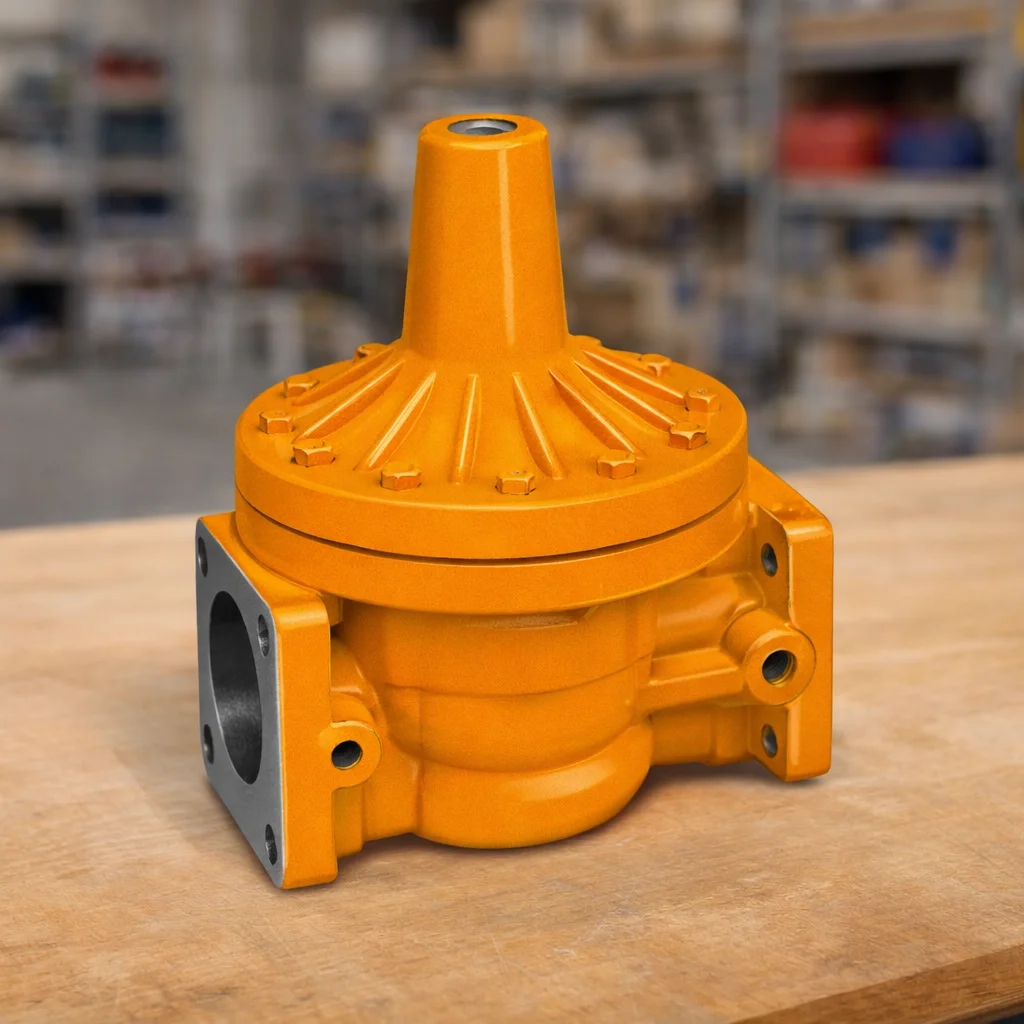
Differential Valves

Differential Valves are essential parts of many liquid transfer systems. They work with air elimination valves to ensure accurate measurement, as well as safe operation. Their main role is simple: to stop product flow through the meter until all vapour has been removed from the system.

How Differential Valves Work

Normally, a Differential Valve stays closed. At pump start-up, liquid enters the system. Therefore, as pressure builds, the spring inside the valve begins to give way. So, once the pressure reaches the set level, the valve opens to allow product to flow.

However, when vapour is being expelled by the vapour eliminator, it is routed to the back of the valve spring. Therefore, this extra pressure, combined with the spring force, keeps the valve closed. So, only when the vapour is gone will the valve open. This prevents measurement errors and protects equipment, as well as improving safety.

Applications

Differential Valves are used in industries where precise liquid measurement is essential. So, for example:

  • Fuel loading, as well as unloading systems

  • Chemical transfer operations

  • Bulk liquid distribution networks

  • Metering systems with vapour eliminators

Choosing and Maintaining Differential Valves

When selecting a Differential Valve, consider the pressure range and the type of liquid, as well as the system conditions. In addition, make sure it is compatible with your vapour eliminator.

Moreover, regular maintenance is essential. Because, springs can weaken, seals can wear, and vapour passages can block over time. So, routine checks keep the valve opening and closing at the correct pressures. Therefore, this ensures long-term accuracy and safety.

Key Features

Our standard 2″ aluminium diaphragm style valve is spring loaded and designed to fail closed. Therefore, the valve provides a constant 15 psi differential pressure and controls flow when vapour is sensed.

The 511-series differential valve is available with an adjustable differential pressure setting of 5 to 16 psi. In addition, this valve is available in ductile iron or cast steel in sizes of 2″, 3″, 4″ or 6″ flanges. These valves are typically used with our MS-series meters and accessories.

Specifications

Model No Material Spring Seals Applications
A2811 Cast Iron Standard Vitron Chlorinated Solvents
A2817 Aluminium Standard Vitron Petroleum Products
A28171 Aluminium Medium Vitron Petroleum Products
A28172 Aluminium Heavy Duty Vitron Petroleum Products
A2821 Aluminium 2650 LPM/ 700 gpm PTFE Liquid Sweeteners, Methanol
A2826 Aluminium Standard Vitron Liquid Sweeteners
A2831 Cast Iron Standard PTFE Caustics
A2851 Aluminium Standard EPT NH³ Applications
A2862 Stainless Steel Standard PTFE Acidic PH Liquids
Model No Material Spring Seals Applications
A3830 Aluminium, Aluminium Guide Standard Vitron Aviation Fuels
A3845 Aluminium, Bronze Guide Standard Vitron Petroleum Products


Model No Material Spring Seals Applications
A4845 Aluminium Standard Vitron Petroleum

Materials of Construction

  • Aluminium
  • Ductile Iron
  • Cast Steel

K7 Valves

  • Used on M5, as well as M7 flow meters – 1½” and 2 ” meters
  • Maximum flow rate = 150gpm (568lpm)
  • Working Pressure: 150psi (10.5bar)

K15 Valves

  • Used on M15, as well as M25 flow meters – 3″ meters
  • Maximum flow rate = 300gpm (1,136lpm)
  • Working Pressure: 150psi (10.5bar)

K30 Valves

  • Used on M30 and M25 flow meters – 3″ meters
  • Maximum flow rate = 300gpm (1,136lpm)
  • Working Pressure: 150psi (10.5bar)

Downloads